
 All Field Notes
Field Notes · On embodiment & change
Beyond the Journey: Somatic Integration and the Body’s Role in Psilocybin Work
Explore body awareness and optional bodywork around psilocybin facilitation, with clear consent, personal meaning, and practical integration.
 By Forest Hart
October 24, 2025
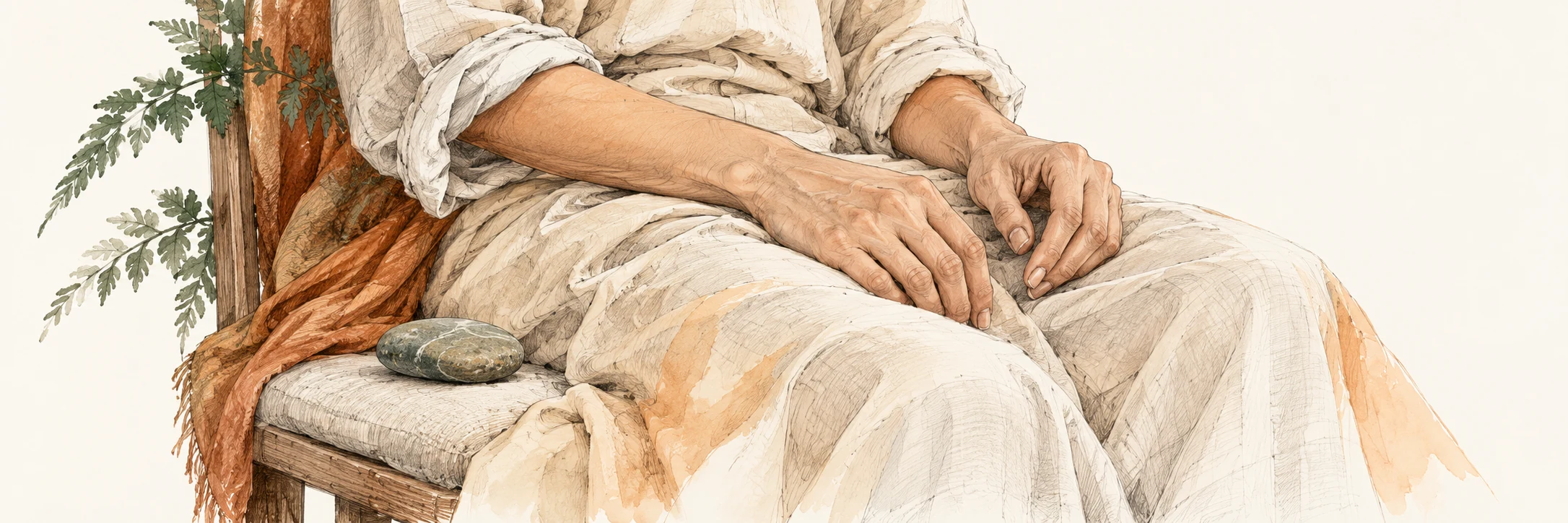
The work doesn’t end when the medicine fades. It continues—quietly, through breath and pulse, long after the visions dissolve.
I approach a psilocybin experience as part of a longer conversation with your life. An insight may feel vivid in the moment and less clear a week later. There can be value in returning to it through words, ordinary choices, and awareness of the body, without assuming it contains a message you must decode.
Somatic practices can be one way of tending that conversation. They are invitations to notice, rather than a requirement for a successful experience. Bodywork is optional; conversation, rest, or another form of support may fit you better.
The Body as the Archive of Experience
Experience can be noticeable in the body. We may tighten the jaw while holding back words, brace the belly in a difficult conversation, or lift the shoulders before a demanding day. Over time, familiar habits can become part of how we recognize ourselves.
Calling the body an archive is a metaphor. A sensation does not prove that a particular event happened, and a practitioner cannot read a person’s history from posture or muscle tension. Warmth, tears, trembling, stillness, or the absence of any strong sensation can all be part of someone’s experience. None requires a predetermined interpretation.
My task is to listen and leave room for your description. If attention to the body feels overwhelming or simply unhelpful, we can change the focus, pause, or consider another kind of support. You do not need to feel more in order to do the work well.
Integration Can Include the Body
Conversation can help give language to something difficult to describe. Body awareness can offer another point of contact: noticing what happens when you speak about a boundary, return to a relationship, or imagine a small change in daily life.
Neither approach is complete for everyone. An insight is not a command, and intensity is not a measure of progress. The useful question may be modest: what deserves attention now, and what can wait?
Bodywork, when wanted, is a separate appointment with its own discussion of goals, consent, and scope. Touch does not need to release stored trauma or produce an emotional response to be worthwhile. You can choose conversation or movement instead, change your preferences, or stop.
Integration can then become less of a task to finish and more of a rhythm: returning to what matters, testing a small practice, and noticing whether it serves the life you actually have.
A Container Around the Experience
I offer private and couples facilitation alongside continuing programs. The current programs page explains the twelve- and sixteen-week private options and the twelve-week couples program.
Preparing the ground
We begin with conversation: what brings you here, what you want support with, your preferences, and the practical limits around you. Reflection and body-awareness practices are possible invitations, shaped with you rather than prescribed as a universal sequence.
The administration session
In Oregon’s service model, psilocybin administration takes place at a licensed service center with a licensed facilitator. That is a distinct setting and agreement. Optional massage or other bodywork described here does not take place as part of the administration session.
Returning to daily life
Integration gives us time to revisit the experience without forcing an immediate conclusion. We may work with reflection, body awareness, or a small practice between meetings. Support is included as described in the package or program you choose; additional time can be discussed when useful. We agree on a rhythm that fits your needs and the support you choose.
Why Skilled Somatic Support Matters
A thoughtful practitioner does not diagnose or translate a psychedelic experience for you. They can help you attend to what you notice while respecting your authority over its meaning.
That includes clear agreements about touch, pacing, privacy, and the limits of the practitioner’s role. A quiet session is not a lesser session. A decision to pause is useful information. Sensations can be met with curiosity without turning every tension or image into a symbol that someone else explains.
For some people, this kind of attention feels grounding. For others, another approach is a better fit. The point is to have choices and enough steadiness to notice what those choices are.
Holding the Metaphor Lightly
It is tempting to explain the whole process through a neat neuroscience story: the medicine opens, the body integrates. That phrase may work as poetry, but it is not an established account of how psilocybin and massage work together.
I do not treat changes in breathing, posture, or emotion as proof that trauma has been released or that a particular brain process has occurred. Research on one practice does not establish that combining it with another will produce the same benefits. Here, the practical emphasis is on consent, attention, and the usefulness of the work in your own experience.
Living Integration
The end of a psilocybin session isn’t the end of the journey—it’s the threshold into practice.
Integration is the long, slow labor of bringing vision into relationship: with food, with movement, with conversation, with stillness. It’s how we make the extraordinary ordinary again, without losing its depth.
Working with a bodyworker, when it is something you want, can offer a different setting for reflection and rest. A session need not be a ceremony or carry a spiritual meaning. The language is yours to choose.
If an altar is a useful image for you, the body can be one place of attention: movement, rest, contact, and the ordinary fact of being here. If that image does not belong to you, we leave it aside.
Returning Home
Every journey deserves care around it, and the body can be a partner in that care without becoming another project to improve.
If you are curious about movement, body awareness, massage, or guided time in nature, Somatic Support describes the current options. Integration explains how reflective support sits around facilitation and continuing programs. We can also discuss whether another practitioner or kind of care would be a better fit.
The invitation is to work with people who listen carefully, ask rather than assume, and respect the ways you make meaning. Returning home does not have to mean arriving at a final answer. It may begin with one ordinary choice that feels more like your own.
Reviewed and updated October 22, 2026.
