
Philosophy & process · Walk With Hart

A steady container. Your own meaning.

Embodied attention, personal symbols, and a way of working that stays responsive to your life. I hold a consistent process while you choose the meanings, questions, and practices that belong to you.

There is room for uncertainty, a change of mind, and your own way of understanding the world.

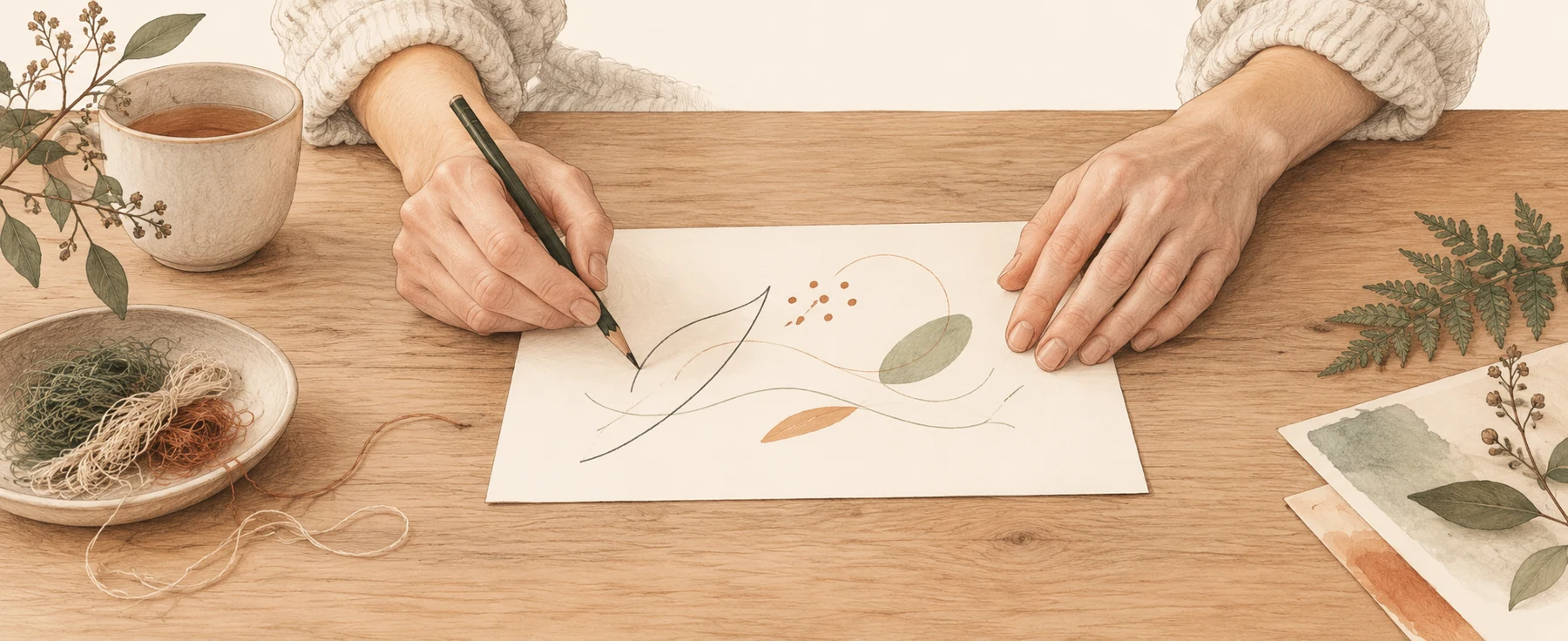
Two hands draw loose personal marks on an unlined card, with a pencil and natural fibers nearby.

The stance beneath the work

Attention before interpretation.

My approach begins with a simple question: what is actually happening here? We can notice the situation, the body, the relationship, and the assumptions we bring before deciding what any of it means.

My practice is shaped by Tai Chi, embodied movement, meditation, and Taoist approaches to awareness. I return to balance within change, the relationship between apparent opposites, and the possibility of responding with less force.

In practice, that might mean giving a question more time, noticing the pressure to find an answer, or discovering that a small adjustment serves you better than a dramatic decision. Nonforcing still allows choice and action. We pay attention to the conditions in which a choice becomes possible.

These influences inform how I accompany you. You can bring a different philosophy, a religious tradition, uncertainty, or no spiritual language at all.

Personal symbols and a living world

Your associations come first.

An image can hold several meanings.

A dream, memory, gesture, phrase, or image may feel important. We begin with your description: its shape, movement, atmosphere, and the connections you notice in your own life. Meaning can remain unfinished or change over time.

Stories, archetypal images, and myths from different traditions can offer other ways to consider an experience. If a story interests you, we can explore its context, what resonates, and what does not fit. Your experience leads the inquiry; it does not have to follow the story’s plot.

You can disagree with an interpretation, leave an image alone, or choose a practical conversation. A sensation or symbol does not establish that a past event occurred.
Relationship extends beyond the individual.

Animist perspectives also shape my attention to relationship: with other people, place, nonhuman life, the things we use, and the responsibilities of belonging. A familiar tree, an everyday object, or a particular landscape may have a place in how you make sense of your life.

We can ask what care, reciprocity, or connection means in your experience. You choose whether your language is spiritual, ecological, relational, metaphorical, or something else.

These are distinct influences with their own histories. I hold them as companions to inquiry and remain curious about the ways you understand the world.

A few ways to notice an image.

If it helps, we can look at form and qualities: shape, texture, weight, or color. We can notice movement and stillness; relationships and distance; edges, openings, and boundaries; who or what can act; and what changes over time. A door might be heavy, partly open, far away, or yours to close. These are optional ways to describe what you experience. They do not decode a person or tell us what an image must mean. Your associations lead, and you can skip any question or choose another way to explore.

Continuity across our work

Six movements to return to.

I hold a repeatable structure so we can return to what matters across meetings. The content stays personal. We can move backward, pause, stay concrete, or spend a whole meeting with one question. These movements describe my approach; they are not a test to complete.

01 / Arrive

Establish the ground.

We check what you need today, what is welcome, and what can remain private. We agree on the pace and the kind of participation that fits.

02 / Attend

Notice what is here.

An ordinary situation, emotion, bodily sensation, image, or silence can be a starting point. You choose the thread. A symbol is never required.

03 / Describe

Give it enough form.

We stay close to your words. Speaking, drawing, or a simple gesture can help you describe qualities and relationships before reaching for an explanation.

04 / Relate

Explore what connects.

We consider your associations and the context of your life. With your permission, a story or image can offer another possible lens to accept, revise, or decline.

05 / Respond

Choose what is useful.

You might choose a conversation, a boundary, rest, a creative act, or a small experiment. An insight creates no obligation to act immediately.

06 / Revisit

Check what still fits.

We return to what happened in ordinary life. What helped? What became a burden? What changed? We can revise the meaning, the practice, or the plan.

This reflective structure belongs chiefly in preparation and integration. During a psilocybin administration session, your immediate needs and the experience unfolding take priority. What to expect explains the service process and practical arrangements.

A simple example

A closed door can stay closed.

Imagine you describe a blue door in a sunlit wall. I would first ask about the door as you experience it. Is it near or far? What do you notice about its edge, its surface, or the space around it?

You might say, “It feels protective. I don't have to let everyone in.” We could stay with that association. If a threshold story interests you, we can explore it together. Opening the door does not become the goal.

Carry it into a real situation.

Perhaps you choose to practice saying “not yet” to one invitation. At our next meeting, we can ask how that went and whether the image still feels useful. You might draw a different door, find another meaning, or feel finished with it.

The same attention works without imagery: noticing what happens when you discuss a boundary, feeling the support of a chair, and choosing a response that fits your actual circumstances.

Choice, consent, and everyday life

The structure serves you.

Our agreements stay open to conversation. You can decline a question, change your mind about an exercise, or ask to pause. Body awareness, movement, writing, and time outdoors are possible invitations. Optional bodywork has its own consent and scope and is arranged separately from administration.

We keep returning to your relationships, capacity, and ordinary responsibilities. We also discuss other kinds of support when your needs fall beyond my role. You do not need a breakthrough, a spiritual encounter, or a finished story to have a worthwhile conversation.

Explore the continuing programs

A place to begin

We can start with a conversation.

Bring your questions, your uncertainty, or simply your curiosity. We’ll talk about what you’re looking for and whether working together feels right.

Let’s talk